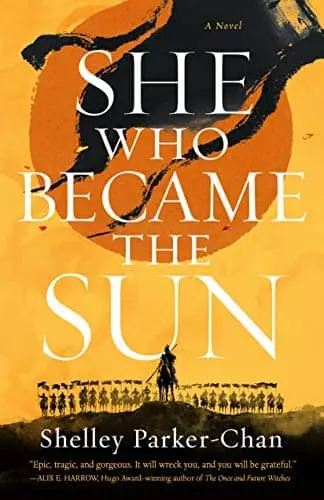
To possess the Mandate of Heaven, the female monk Zhu will do anything
Mulan meets The Song of Achilles in a bold, queer, and lyrical reimagining of the rise of the founding emperor of the Ming Dynasty from an amazing new voice in literary fantasy.
"I refuse to be nothing..."
In a famine-stricken village on a dusty yellow plain, two children are given two fates. A boy, greatness. A girl, nothingness...
In 1345, China lies under harsh Mongol rule. For the starving peasants of the Central …
To possess the Mandate of Heaven, the female monk Zhu will do anything
Mulan meets The Song of Achilles in a bold, queer, and lyrical reimagining of the rise of the founding emperor of the Ming Dynasty from an amazing new voice in literary fantasy.
"I refuse to be nothing..."
In a famine-stricken village on a dusty yellow plain, two children are given two fates. A boy, greatness. A girl, nothingness...
In 1345, China lies under harsh Mongol rule. For the starving peasants of the Central Plains, greatness is something found only in stories. When the Zhu family's eighth-born son, Zhu Chongba, is given a fate of greatness, everyone is mystified as to how it will come to pass. The fate of nothingness received by the family's clever and capable second daughter, on the other hand, is only as expected.
When a bandit attack orphans the two children, though, it is Zhu Chongba who succumbs to despair and dies. Desperate to escape her own fated death, the girl uses her brother's identity to enter a monastery as a young male novice. There, propelled by her burning desire to survive, Zhu learns she is capable of doing whatever it takes, no matter how callous, to stay hidden from her fate.
After her sanctuary is destroyed for supporting the rebellion against Mongol rule, Zhu uses takes the chance to claim another future altogether: her brother's abandoned greatness.
The characters and events have an inertia and intention to them that grows a particular aesthetic, as though this is how things had to happen. It's an epic poem, almost.
The book was betrayed a little by a secondary plot that kept less of my interest than the primary one. I think it makes up for that with fascinating exploration of pre-Ming China's traditions of gender roles and destiny, in a way I encountered as alien yet relevant.
I recommend this as a beautiful artwork, a rumination on identity and empire.
I love this book for being an alternate history that's not fixated on Hitler. I love it for how carefully it weaves its fantasy into the real history it's anchored in - enough so that as soon as I finished reading it I had to read up on the actual Red Turban rebellion and see how many of the characters were close adaptations. I love it for how much desperate, furious, and yes sometimes joyous life its main characters have. I love it for how viscerally it evokes some incredibly hard times (though be warned, it's a heavy read because of that). I love it for how utterly unsympathetic all the "big people" are.
Around the middle of the book the weight of Fate on both the plot and multiple characters' obsessions started to feel stifling, but the more the narrator complicated that idea the more this stopped being a problem.