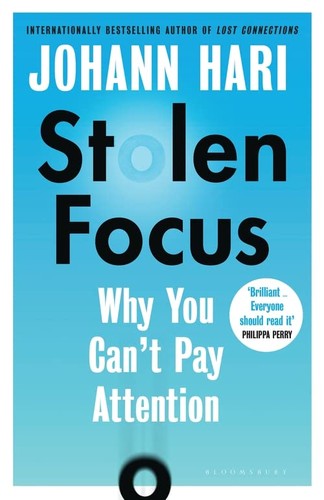
In the United States, teenagers can focus on one task for only sixty-five seconds at a time, and office workers average only three minutes. Like so many of us, Johann Hari was finding that constantly switching from device to device and tab to tab was a diminishing and depressing way to live. He tried all sorts of self-help solutions—even abandoning his phone for three months—but nothing seemed to work. So Hari went on an epic journey across the world to interview the leading experts on human attention—and he discovered that …
In the United States, teenagers can focus on one task for only sixty-five seconds at a time, and office workers average only three minutes. Like so many of us, Johann Hari was finding that constantly switching from device to device and tab to tab was a diminishing and depressing way to live. He tried all sorts of self-help solutions—even abandoning his phone for three months—but nothing seemed to work. So Hari went on an epic journey across the world to interview the leading experts on human attention—and he discovered that everything we think we know about this crisis is wrong.
We think our inability to focus is a personal failure to exert enough willpower over our devices. The truth is even more disturbing: our focus has been stolen by powerful external forces that have left us uniquely vulnerable to corporations determined to raid our attention for profit. Hari found that there are twelve deep causes of this crisis, from the decline of mind-wandering to rising pollution, all of which have robbed some of our attention. In Stolen Focus, he introduces readers to Silicon Valley dissidents who learned to hack human attention, and veterinarians who diagnose dogs with ADHD. He explores a favela in Rio de Janeiro where everyone lost their attention in a particularly surreal way, and an office in New Zealand that discovered a remarkable technique to restore workers’ productivity.
Crucially, Hari learned how we can reclaim our focus—as individuals, and as a society—if we are determined to fight for it. Stolen Focus will transform the debate about attention and finally show us how to get it back.
Nun denn. Die Welt zu retten klang schon komplizierter.
3 Sterne
So ganz nutzlos wirkt das Buch trotzdem nicht. Man erwischt sich bei häufigem Augenrollen ob der ganzen eh-klar-Selbstverständlichkeiten ebenswo wie beim zustimmenden Kopfnicken. Wie erfrischend.
An eye-opening book showing how the modern world is making us addicted to the constant flow of information, turning us miserable and constantly distracted
5 Sterne
I think Johann Hari did a great job at researching and covering the topic of how the way we currently live in the modern world does a great deal of harm to our minds. We are addicted to the constant flow of information, miserable, often unable to focus on tasks and involuntarily reaching for our smartphones for the so much craved shots of dopamine. It turns out that it's not really an individual issue anymore. In part thanks to our consumerist society, social media giants, food companies, pharmaceutical industry etc. which all have a financial incentive to have the world this way + other environmental factors outside of our control, it's impossible to come out clean out of this mess. As the author states, there isn't a simple solution to this problem. However, there are still certain strategies and techniques that you as an individual can employ to stay happy, …
I think Johann Hari did a great job at researching and covering the topic of how the way we currently live in the modern world does a great deal of harm to our minds. We are addicted to the constant flow of information, miserable, often unable to focus on tasks and involuntarily reaching for our smartphones for the so much craved shots of dopamine. It turns out that it's not really an individual issue anymore. In part thanks to our consumerist society, social media giants, food companies, pharmaceutical industry etc. which all have a financial incentive to have the world this way + other environmental factors outside of our control, it's impossible to come out clean out of this mess. As the author states, there isn't a simple solution to this problem. However, there are still certain strategies and techniques that you as an individual can employ to stay happy, healthy and actually focused on what's important, which are also covered here.
The book isn't exactly perfect. Still, in my opinion, more attention should be given to the issues presented in this work. I feel how on personal level it's harder for me to just stop looking at social media or youtube (all of which actually became less social are more like platforms for advertising) and do things that actually matter. I notice that others experience a similar thing themselves and this book is a great start to actually notice and understand the problem. I recommend it wholeheartedly.