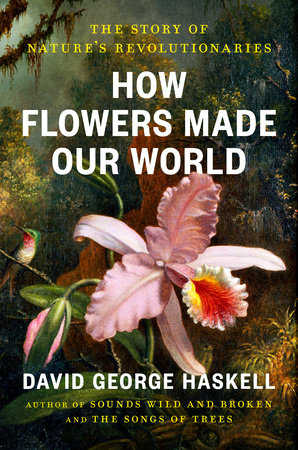

Soh Kam Yung hat How Flowers Made Our World von David George Haskell besprochen
A fascinating book about flowering plants
4 Sterne
A fascinating book that looks at flowers and flowering plants, which now make up the majority of plants in the modern world. The author shows the relationship between these plants and their pollinators, the ecology of plants, how plants feed us and enrich our lives, and what may be in store for plants in a world of rapid ecological change.
What follows is a summary of each chapter in the book.
The author first looks at Magnolias, one of the oldest known flowering plant. Like most flowering plants, it contains the male and female parts. The female parts mature first, accepting pollen bought by pollinating insects attracted by the magnolia's scent. The male parts then mature, and the magnolia makes a more powerful scent to attract more pollinators to bring the pollen to other plants. Once fertilised, the flowers turn into seeds and fruits to attract birds to …
A fascinating book that looks at flowers and flowering plants, which now make up the majority of plants in the modern world. The author shows the relationship between these plants and their pollinators, the ecology of plants, how plants feed us and enrich our lives, and what may be in store for plants in a world of rapid ecological change.
What follows is a summary of each chapter in the book.
The author first looks at Magnolias, one of the oldest known flowering plant. Like most flowering plants, it contains the male and female parts. The female parts mature first, accepting pollen bought by pollinating insects attracted by the magnolia's scent. The male parts then mature, and the magnolia makes a more powerful scent to attract more pollinators to bring the pollen to other plants. Once fertilised, the flowers turn into seeds and fruits to attract birds to disperse the seeds. Here, Magnolias shows the initial relationships between flowering plants and its pollinators.
Next, the author looks at Tragopogon, or Goatsbeard. It is a plant now introduced to many places. In some places, different species of Goatsbeard grow next to each other and produced fertile hybrids which have four copies of chromosomes, instead of the usual two. Modern Genetics has showed that in the past, flowering plants have duplicated their genomes several times, then pruned them back. These extra genes allowed plants to experiment with new features and adapt to new stressful environments. Many of today's crop plants are the result of hybrids with duplicate genomes.
Orchids are the subject of the next chapter. This is one of the most species rich plant family, with a tight dependence on pollinators and fungi to spread and grow. Some orchids are parasites of fungi, and also deceive their pollinators by appearing to offer nectar. Orchids do this because they are frugal plants, producing only a little pollen which they stick on specific pollinators. Orchid seeds are small, and depend on fungi to start growing. Because the seeds are small and hard to grow, horticulture orchids are usually grown from cuttings or cells. Since orchid pollinators are usually plant specific, mutations that cause changes in pollinators can rapidly give rise to new orchid species.
Next comes grass, small plants that grow on grasslands. Grass has a relationship with fire, for it removes trees that compete with it. Despite appearances, grasslands can be very biodiverse, supporting many species of plants, insects, birds and grazing mammals. Human also depends on grass: rice, maize, wheat are all grasses. Unlike orchids, grass provide their seeds with large amounts of nutrients to grow (endosperm), which we eat. Compared to other plants that protect their seeds with toxins and require processing to be eaten, grass can be easily eaten. Our crops are genetic mutations of grass that do not release their seeds when mature, making it easy to harvest. Some grasses also use the more efficient C4 photosynthesis, which converts more CO2 into nutrients.
Related to grass is seagrass, a plant that went back into the sea. Sea grasses build their own ecosystem by accumulating sediment, helping to protect the shores like salt marshes or mangroves. They can store carbon faster than land plants and serve as food for marine life and birds. They are also a nursery for young sea creatures. Descended from land plants, seagrass still have tiny flowers. They are use lignin, inherited from land plants, for strength, allowing them to withstand ocean storms. There are now efforts to restore sea grasses to help combat rising oceans and climate change.
The rose is the subject of the next chapter. Besides being pretty, roses and related plants give out scents that we find pleasing. This leads to the creation of perfumes, like in the Grasse region of France. Interestingly, perfumes got their start by scenting leather gloves, before becoming their own industry. Perfume smells are given off by volatile chemicals, originally used by plants as signals to coordinate growing, deter herbivores and to attract pollinators. These plant scents overlap with odours that people find attractive. Some scents have antibacterial and antifungal properties, leading to medicinal use.
Next, is a look at tea. This chapter tells the story of Carl Linnaeus and his idea for plant classification, based on the characteristic of flowers (number of male and female parts). This classification turns out to be useful: flowers are variable enough but not too variable, which allows plants to be put into various families without too many disputes. Linnaeus was more interested in the economic value of plants, and attempted to grow tea in Sweden. A consequent of these, and attempts by others to grow other commercial crops was colonialism, slavery by European powers eager to grow such cash crops.
The Pansy is covered in the next chapter. The author looks at flower breeding and floral display shows. While these shows delight the senses, may of the plants featured in such shows are devoid of pollinators, because they are hybrids with features we want, like more petals and extravagant flowers, features which deny access to pollinators. Such hybrids and other non-native flowers (which local pollinators may not like) are also taking over many areas, reducing biodiversity. Encouraging flower breeders and plant shows to feature native flowers may be one way to encourage more biodiversity.
In the last chapter, the author speculates on the future of flowers by looking at the future of plants in the immediate and far future. The spread of non-native plants and climate change is a concern. But some arid areas like Australia and Southern Africa are surprisingly biodiverse, showing it is possible to regain biodiversity even in extreme conditions. But this may only be possible if there are still places for plants to grow. In long term, plants may recover, but areas with high pollution, like mines, may take more time to recover.
The author closes the book with a supplement. It looks at ways people can experiment with and enjoy plants and the aroma of flowers in our homes or in our daily lives.