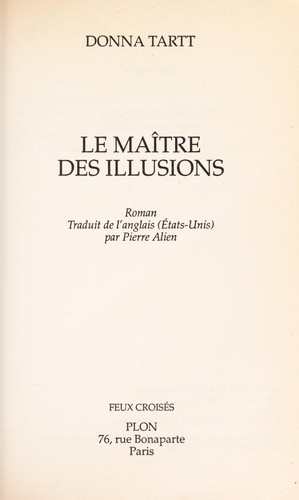
Par sa surprenante erudition et son sens percutant du suspense psychologique, par sa richesse des sentiments, des idees et de la langue, Le Maitre des illusions fait une entree remarquee dans le domaine du roman d'aventures. Il s'agit des confessions, des annees plus tard, d'un jeune etudiant d'une petite universite du Vermont ayant enfin accede a cette vie intellectuelle privilegiee tant convoitee.Introduit dans le cercle tres ferme de cinq etudiants surs d'eux-memes et du monde, choisis par un professeur charismatique de lettres classiques, Richard Papen s'initie avec eux aux mysteres …
Par sa surprenante erudition et son sens percutant du suspense psychologique, par sa richesse des sentiments, des idees et de la langue, Le Maitre des illusions fait une entree remarquee dans le domaine du roman d'aventures. Il s'agit des confessions, des annees plus tard, d'un jeune etudiant d'une petite universite du Vermont ayant enfin accede a cette vie intellectuelle privilegiee tant convoitee.Introduit dans le cercle tres ferme de cinq etudiants surs d'eux-memes et du monde, choisis par un professeur charismatique de lettres classiques, Richard Papen s'initie avec eux aux mysteres de la culture grecque ancienne et passe en leur compagnie de longs week-ends a lire, faire du bateau et jouir des journees ensoleillees de l'ete indien. Magnetise par ses nouveaux compagnons, Richard n'a pas connaissance du crime qu'ils ont commis au cours d'une bacchanale.Mais une fois mis dans la confidence, il s'incline devant l'ineluctable necessite d'assassiner leur camarade de classe et ami qui pourrait trahir leur secret et compromettre leur avenir. D'une lecture irresistiblement prenante, cette chronique de l'illusion et de la complicite, de l'abandon aux rites dionysiaques, de l'innocence corrompue par l'egoisme et l'arrogance morale est aussi une histoire de culpabilite et de responsabilite. Ce premier livre audacieux revele en Donna Tartt une jeune romanciere de grand talent. "Comme roman policier, c'est un des meilleurs que j'ai jamais lus.Mais comme premier roman, il m'a coupe le souffle, tant il est maitrise." Ruth Rendell
Keine Ahnung, wie die Autorin das schafft, aber man ist sofort in dieser Geschichte drin.
Ich habe mich sogar dabei ertappt, wie ich einen Mord rechtfertigte...
Richard, aus einfachen Verhältnissen stammend, erzählt uns vom Beginn seines Studiums an der Uni.
Er bekommt Anschluss an eine Clique aus exzentrischen Außenseitern.
Diese sind alle Kinder reicher Eltern und tun Kinder-reicher-Eltern-Dinge. Irgendwann eskaliert es und jemand stirbt.
Das Buch beschäftigt sich hauptsächlich damit, was das mit den einzelnen Protagonisten, aber auch mit dem Gruppengefüge macht.
Da geht es plötzlich um existenzielle und ethische Fragen, ganz konkret anstatt theoretisch wie im Altgriechischkurs der Freunde.
This is a book that overstays its welcome, though I do feel like that's kind of the point.
Split into two parts (or 'books'), the first one is far more engaging than the second. Perhaps it's because all of the action for what transpires happens in the first book. You see the frustration and the conspiracy between the primary characters, and it finally culminates in what every other character in the book believes to be a tragic "accident."
The second part basically unravels those primary characters, both for the reader and for the characters. But this is where it feels like it overstays everything, and I stopped caring about any of what was happening. I had to force myself to finish this bit, and I felt compelled because I was already so far into the book. It was a slog.
This isn't helped because, at no point, …
This is a book that overstays its welcome, though I do feel like that's kind of the point.
Split into two parts (or 'books'), the first one is far more engaging than the second. Perhaps it's because all of the action for what transpires happens in the first book. You see the frustration and the conspiracy between the primary characters, and it finally culminates in what every other character in the book believes to be a tragic "accident."
The second part basically unravels those primary characters, both for the reader and for the characters. But this is where it feels like it overstays everything, and I stopped caring about any of what was happening. I had to force myself to finish this bit, and I felt compelled because I was already so far into the book. It was a slog.
This isn't helped because, at no point, are any of these characters really interesting people who you can like. They're all entirely unlikable, but it's unlikable in a way that a person sees a particularly rotten politician. You don't want to follow their movements, but you're compelled to because of external forces. Many of them aren't interesting, though I also feel that this is the point. These characters are incredibly shallow and perceive superficial but grand gestures as being the only way through a problem.
Probably the most interesting bit of the second 'book' is the part where the protagonist starts to believe that his actions were part of the plan all along, even when he didn't recognise it as being something that could so easily be controlled. But so many threads of interest were used in ways that were entirely underwhelming or felt completely dropped, and that was one.